
Who Do We Trust Before They Have Spoken?
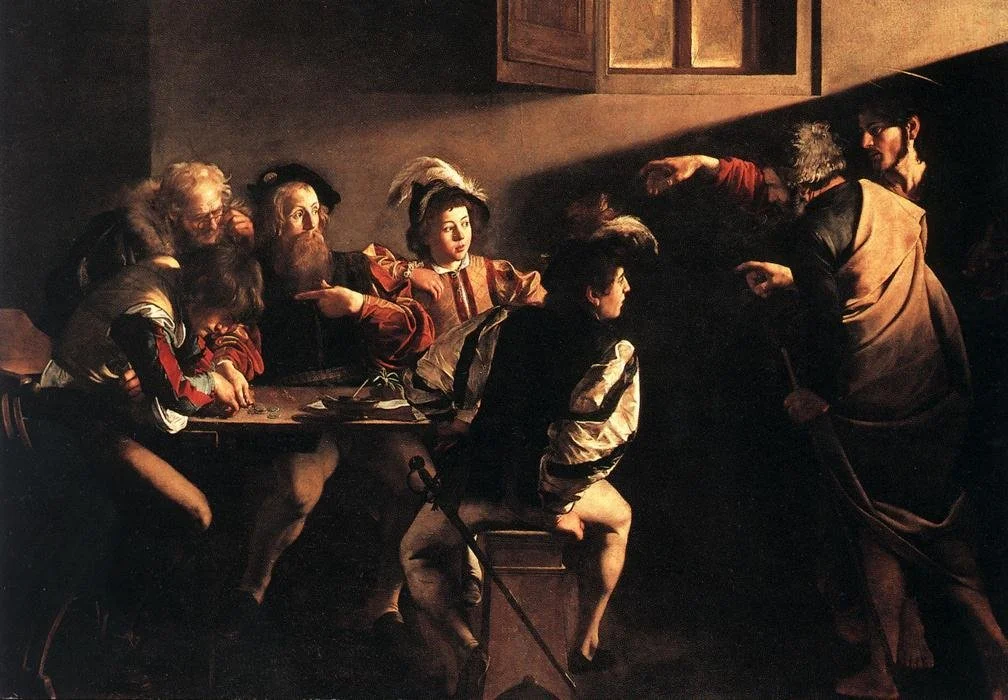
Caravaggio’s The Calling of Saint Matthew asks who is being noticed, trusted and called into the story. Image: Michelangelo Merisi da Caravaggio, The Calling of Saint Matthew, 1599–1600, Contarelli Chapel, San Luigi dei Francesi, Rome. Photo: Scala / Art Resource, NY. Via the Visual Commentary on Scripture
A sermon preached by the Revd Ruth Edmonds at St Philip and St James, Leckhampton, during our Season of Listening.
Readings: James 2:1–9 and Mark 10:46–52
The seating plan reveals the church's theology. It tells us whose presence matters, whose voice carries weight, and who may shape what happens.
The seating plan
James gives us an extraordinarily physical picture of a church.
Two people arrive.
One is dressed beautifully and wears gold rings.
The other is poor and inadequately dressed.
And immediately, before either has spoken, the community assigns them their places.
"You sit here."
"You stand there."
"You sit at my feet."
The seating plan reveals the church's theology.
It tells us whose presence matters.
Whose voice carries weight.
Who may shape what happens.
And who should remain grateful simply to have been allowed inside.
We may not reserve our best seats for people wearing gold rings.
But we still notice confidence.
Education.
Familiarity with how church works.
I know that I find it easier to trust people when conversation flows easily between us. When they understand the things I care about. When we already share a way of looking at the world.
And ultimately, for me it’s about pubs. Do they seem like someone who would be comfortable in their local - whether they drink soda or beer? Somehow there are pub people and people who don’t know how to be in a pub - and I feel naturally easier with pub people.
Perhaps we all do.
But partiality begins when we decide how much weight a person's voice carries before they have spoken.
And churches can be exceptionally warm while leaving that hidden seating plan untouched.
Everybody may be welcome.
But it may remain surprisingly unclear how anybody becomes involved.
How they are trusted.
How their gifts are recognised.
How they become able to shape our common life.
James calls us back to what he names the royal law:
"You shall love your neighbour as yourself."
Not tolerate your neighbour.
Not provide something nice for your neighbour.
Love them as somebody through whom God may address you.
The voice beside the road
And then Mark gives us Bartimaeus.
He has already been assigned his place.
He is blind.
He is begging.
He is beside the road.
Jesus and the crowd are going somewhere.
Bartimaeus is not part of the movement.
He is permitted to be present at the roadside, but not to interrupt what everyone else is doing.
And when he cries out, the crowd tells him to be quiet.
But Bartimaeus becomes louder.
That detail matters.
Because we often find repeated voices tiring.
We think:
We have heard this before.
Why are they raising it again?
Why can they not express it more calmly?
But sometimes repetition means that somebody has spoken before without being heard.
Sometimes sharpness is what remains after gentleness has failed.
Sometimes a person has learned that a quiet voice is very easy to ignore.
Then Mark tells us:
"Jesus stood still."
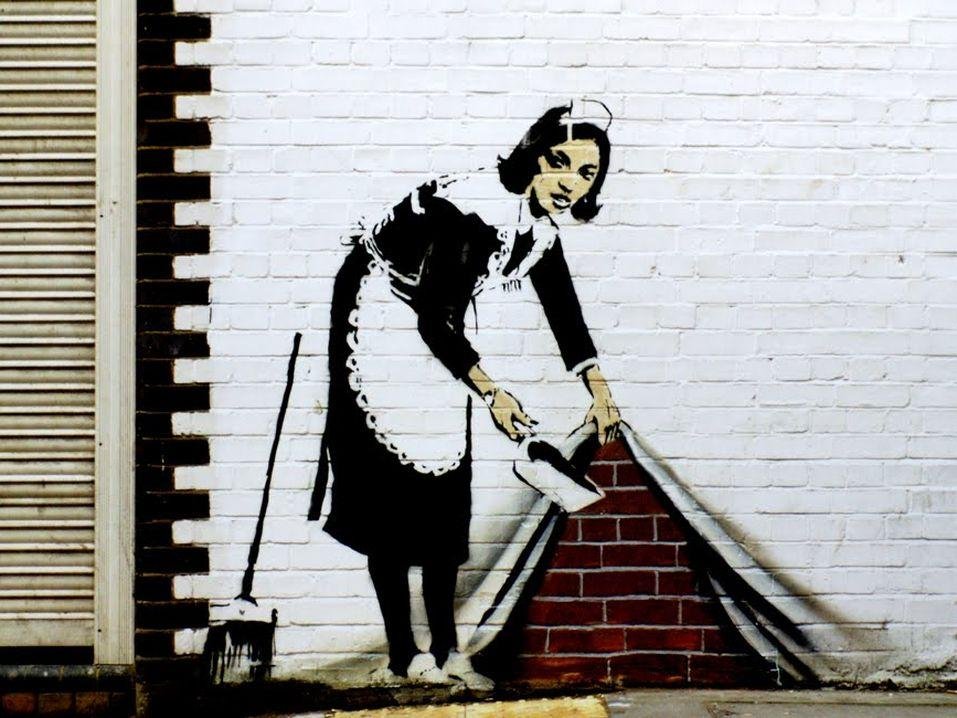
Banksy brings into public view someone whose work would ordinarily remain overlooked. Image: Banksy, Maid in London (Sweeping It Under the Carpet), 2006, formerly at Chalk Farm, London. Photo: ArtAngel / Alamy Stock Photo. Via the Visual Commentary on Scripture
Jesus is on the way.
There is somewhere to go.
Something important is about to happen.
But Jesus stops.
The miracle begins before Bartimaeus receives his sight.
It begins when the movement of the crowd no longer matters more than the voice beside the road.
And there is another detail here which Paula Gooder's close attention to Mark's storytelling helps us notice.
Just before this encounter, Jesus asks James and John:
"What is it you want me to do for you?"
And they ask for the best seats.
One at his right hand.
One at his left.
Then Jesus meets Bartimaeus and asks almost exactly the same question:
"What do you want me to do for you?"
James and John ask for seats.
Bartimaeus asks for sight.
The insiders want status.
The outsider wants to see.
And Bartimaeus, even before his physical sight is restored, perceives something the disciples are still struggling to understand.
He calls Jesus "Son of David."
The man the crowd assumes needs everything from them already carries insight they need to receive.
That is why Jesus asks him the question.
Not because his need is impossible to guess.
But because Bartimaeus is not an object of compassion.
He is a person with agency, desire, faith and knowledge of his own life.
Jesus does not answer for him.
He makes room for Bartimaeus to speak.
And Jesus shares that encounter with the crowd.
He does not walk over to Bartimaeus himself.
He tells them:
"Call him here."
The people who had become a barrier must now carry Christ's invitation.
First they say:
"Be quiet."
Then they say:
"Take heart. Get up. He is calling you."
Jesus does not replace the crowd.
He changes it.
The people who silenced Bartimaeus become the people entrusted with calling him forward.
That is both uncomfortable and hopeful.
Because it means we are not permanently divided into enlightened listeners and terrible silencers.
Christ can show us what we have failed to hear.
Christ can interrupt our momentum.
Christ can teach us to change our words.
Sometimes repetition means that somebody has spoken before without being heard. Sometimes sharpness is what remains after gentleness has failed.
From the edge to the shared road
And I think something of that life is already growing among us.
People have brought doubts here and discovered that doubt does not place them outside the Church.
Children have said what they need and found that somebody believes them.
People who once stood quietly at the edge have gradually discovered their own voice, their gifts and their place among us.
Some people belong through worship.
Some through coffee, conversation, music, justice or service.
Some are not yet sure whether they belong at all.
But again and again, I see God creating enough safety for somebody to take another step.
These may seem like small things.
But resurrection often begins like this.
Not with everything suddenly fixed.
But with somebody discovering that fear, silence or an old identity no longer has the final word.
And I wonder what kind of church becomes possible when we stop thinking of the centre and the edges as fixed places.
What if somebody can arrive through the café, the toddler group, a concert or a conversation, and already be part of what God is doing among us?
What if the person who rarely sits in a pew may still have something vital to teach us about faith, belonging or hope?
What if our task is not always to draw everybody towards the institutional centre, but to recognise Christ moving among us at many different distances?
A church shaped like that would not ask only:
"How do we bring more people in?"
It would also ask:
"Where is God already present, and how might we join in?"
Listening is not the same as agreeing
This is part of what our Season of Listening is about.
It is not a customer satisfaction survey.
We are not asking everybody what they want and promising to provide it.
James and John tell Jesus what they want, and Jesus does not give them the seats they request.
Listening must be followed by discernment.
The roots of this process lie in the Ignatian tradition.
Ignatius encourages us to pay attention to the movements within and among us.
What leads towards greater faith, hope and love?
What creates courage, freedom and connection?
What helps us love God and our neighbour more deeply?
And what draws us towards fear, defensiveness or control?
Discernment also means asking a harder question: is what we are hearing rooted in Christ, or has it quietly become a conversation about ourselves?
Does it deepen prayer, scripture and worship, or only community and comfort?
A church can be warm and busy and still lose its centre.
So we test what we hear not only by whether it enlarges love, but by whether it draws us closer to Christ himself.
Not every uncomfortable voice is prophetic.
But neither is every uncomfortable voice merely negative.
Some voices express grief and need tenderness.
Some express preferences which deserve acknowledgement but not necessarily action.
Some reveal prejudice which requires repentance.
And some ask difficult questions that may deepen the faith and calling of the whole Church.
What are we prepared to share?
I wonder if this is not about granting every request, but about becoming willing to share.
To share attention with people whose stories take time.
To share responsibility with people who do not already know how everything works.
To share the interpretation of what God is doing with people whose experiences differ from our own.
Because the person who arrives needing something may also carry something we need.
We are all recipients of grace.
But nobody should be held permanently as only a recipient.
Bartimaeus receives healing from Jesus.
But the community receives something from Bartimaeus:
his insight,
his faith,
his companionship on the road.
The story does not end with Bartimaeus returning to his old place.
Mark tells us that he follows Jesus "on the way."
He moves from beside the road to sharing the road.
Perhaps that is the Church Christ is calling us to become.
Not a room in which people compete for the best seats.
Not a generous centre surrounded by grateful people at the edges.
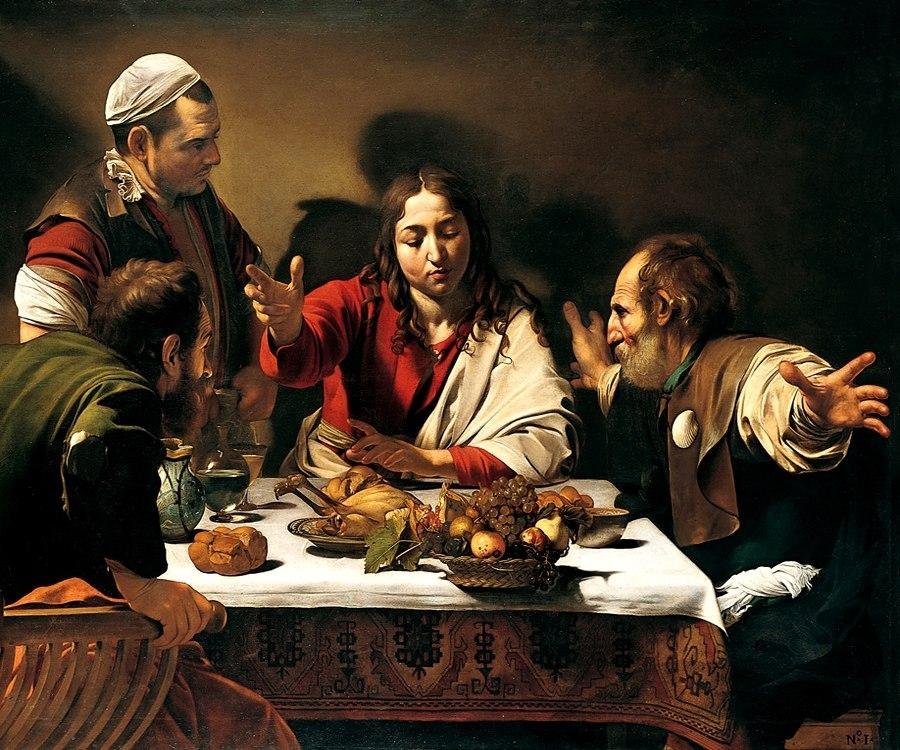
Recognition happens among companions around a shared table. Image: Michelangelo Merisi da Caravaggio, The Supper at Emmaus, 1601, The National Gallery, London. © The National Gallery, London / Art Resource, NY. Via the Visual Commentary on Scripture
But a people sharing the road.
A place where people may bring doubt and discover that honesty is welcome.
A place where the broken can rest without being treated as projects.
A place where people working for justice can be strengthened and sent out again.
A place where children, newcomers and those who do not possess institutional confidence may help us recognise what God is doing.
A place where we encounter Christ in prayer, Scripture, bread and wine, and then discover that Christ has also been calling to us from beside the road.
This is not a finished church.
Thank God.
It is a church still being called.
Still being changed.
Still discovering that Christ is already present in people we imagined were waiting for us to bring Christ to them.
So perhaps the question for this listening season is not simply:
"Have we allowed everybody to speak?"
It is:
"What are we prepared to share?"
Are we prepared to share the road with people whose presence may change our direction?
And perhaps each of us might begin by listening for one voice we would normally overlook.
Not in order to agree automatically.
Not in order to solve or manage.
But to ask what God might be showing us through this person.
James and John ask for seats.
Bartimaeus asks for sight.
And Jesus creates a community in which the crowd can change, the silenced can speak, and the person at the roadside can become a companion on the way.
That is the church I hope we are becoming.
A people learning to see.
Learning to listen.
Learning to share the road.
So take heart.
Get up.
He is calling us.
Amen.
This sermon forms part of our Season of Listening. You do not need to answer every question. Take your time, choose one, and consider talking it through with somebody else.