
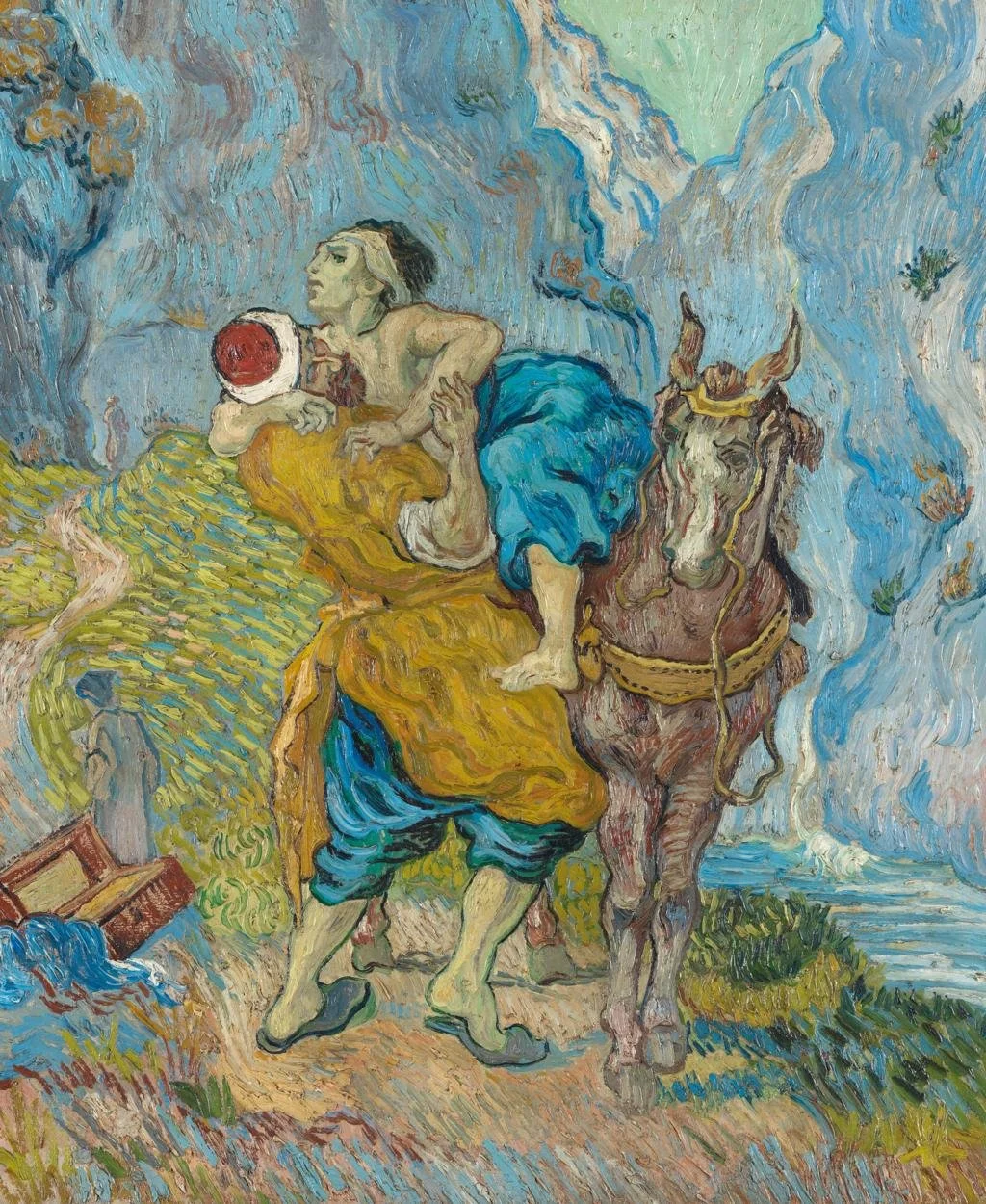
The Good Samaritan (after Delacroix) – Vincent van Gogh
What if the Good Samaritan isn't really a story about identifying who deserves our kindness, but about becoming the kind of person who draws near?
A reflection on Luke 10:25–37 and Leviticus 19:9–18, 33–34, preached by Amanda Thistleton at Pip & Jim's, 11 October 2026.
“Go and do likewise.”
I could almost stop there.
The parable of the Good Samaritan is probably one of Jesus' best-known stories. Most of us have grown up with the image of an unlikely stranger going out of his way to help someone in need. We know the message: be kind, help people, don't walk past suffering.
It makes very good sense. We could take that advice and get on with our day.
But perhaps Jesus is asking something rather more challenging of us.
Who counts as my neighbour?
The story begins with an expert in the law asking Jesus a question: “What must I do to inherit eternal life?”
Jesus turns the question back on him. What does the law say?
The man knows his scriptures. Love God with all your heart, soul, strength and mind. Love your neighbour as yourself.
And he's right.
Leviticus, which lies behind his answer, is remarkably practical about what loving your neighbour involves. It speaks of economic justice, fair treatment of workers, care for vulnerable people and love for the stranger living among us.
Love isn't simply a feeling. It has consequences for how we organise our lives, use our resources and treat the people around us.
But the lawyer wants to narrow things down.
“And who is my neighbour?”
It's an interesting question. Perhaps what he's really asking is: How far does my responsibility extend? Where can I draw the line? What's the minimum required of me?
We might recognise something of ourselves in that question.
Who is my neighbour?
The woman next door? The person sitting beside me at work? The man at the supermarket checkout?
Certainly.
But what about the asylum seeker? The person who always parks too close to my driveway? The colleague who criticises me? The person whose political views I find deeply troubling?
What about the people I find difficult, inconvenient or simply don't understand?
Jesus doesn't give the lawyer a list of people who qualify. Instead, he tells a story that turns the whole question around.
The question becomes not Who is my neighbour? but Am I willing to become a neighbour?
Imagine yourself beside the road
We usually hear this parable from the perspective of the people walking along the road. We ask ourselves whether we would behave like the priest, the Levite or the Samaritan.
But for a moment, imagine being the injured traveller.
You're lying beside a lonely, dusty road. You've been beaten, robbed and left for dead.
The heat is unbearable. Your body aches. Blood and dust sting your eyes. You're desperately thirsty.
You hear footsteps approaching.
Relief.
Someone is coming.
But the footsteps move away. The first traveller passes on the other side.
Silence returns.
Then another person appears. He comes close enough to see you. Perhaps you try to call out, but you can barely speak.
He too moves away.
You're alone again.
And then you hear the sound of another traveller approaching.
A man kneels beside you. You feel his hands gently lifting your shoulders. Cool water touches your lips. He cleans the blood from your face, washes your wounds and begins to bandage them.
You look up.
He's a Samaritan.
Someone you would never have expected to help you. Someone you might have been taught to distrust.
Yet here he is.
He lifts you onto his donkey, takes you somewhere safe and makes sure that you will be cared for.
What must that encounter have felt like?
To be seen when others had looked away. To be touched with gentleness after experiencing violence. To discover compassion in the person you least expected.
Perhaps the injured traveller would never see the world in quite the same way again.
Take a moment to sit with that image. What does it feel like to receive kindness from someone you never expected to offer it?
Compassion that crosses boundaries
There is something especially striking about the way Jesus describes the Samaritan.
When he sees the injured man, he is moved with compassion.
The Greek word used here is splagchnizomai. It suggests something deeper than sympathy: compassion felt in the very depths of a person.
It's a word the Gospels also use to describe Jesus' own compassion.
And perhaps that gives us another way of reading the story.
The Samaritan, despised and rejected by those who regarded him as an outsider, becomes an image of Christ himself.
He draws near to suffering. He tends wounds. He offers care without first demanding that the injured man prove himself worthy of it.
This is what the love of God looks like when it takes flesh.
Not love at a safe distance, but love that crosses the road.
Not compassion as a pleasant sentiment, but compassion that costs something: time, money, inconvenience, vulnerability.
And, perhaps most radically, love that refuses to be confined by the boundaries we have drawn between ourselves and others.
What would it mean to become a neighbour?
At the end of the parable, Jesus asks the lawyer which of the three travellers became a neighbour to the injured man.
“The one who showed him mercy,” the lawyer replies.
“Go and do likewise.”
It's a simple instruction, but not necessarily an easy one.
It asks us to notice the people we might otherwise overlook. It asks us to resist the temptation to decide in advance who deserves our attention or care.
And it invites us to see Christ not only in the person offering compassion, but also in the person who needs to receive it.
Sometimes becoming a neighbour might involve something enormous: standing alongside someone experiencing injustice, challenging prejudice, or offering practical support to someone whose life has fallen apart.
But sometimes it begins with something very small.
A message to someone who has been on our mind. A phone call. An invitation for coffee. Taking the time to listen rather than hurrying past.
Perhaps there is someone you have been meaning to contact.
Perhaps there is someone you find difficult to love.
Perhaps there is someone whose suffering you have noticed, but whose needs feel inconvenient or overwhelming.
Or perhaps, today, you are the person lying beside the road, longing for someone to notice.
The extraordinary promise of this story is that compassion can arrive from unexpected places, and that the boundaries we imagine between ourselves and others need not have the final word.
Jesus doesn't ask us to work out who is worthy of being our neighbour.
He asks us to become one.
So here is a question to carry into the week: To whom is God calling you to draw near?
“Brother, sister, let me serve you, let me be as Christ to you.”
Amen.