

What if welcoming people means being willing to let them change the communities we love?
The God Who Has Not Finished Speaking
What happens when God begins doing something that doesn't quite fit the way we've always understood things? And what if being a welcoming church means allowing ourselves to be changed by the people who come through our doors?
Revd Ruth Edmonds reflects on Acts 15:1–22a and John 16:12–15, and what our Season of Listening might teach us about the Holy Spirit, belonging and the future of the Church.
The Church began with an argument
There is something rather wonderful about the fact that one of the earliest great meetings of the Christian Church was, essentially, an argument.
Not a particularly polite disagreement about the colour of the curtains or the timing of the coffee rota.
A proper argument. About belonging. About tradition. About who was allowed in, and on what terms.
The question was whether Gentiles — people who hadn't grown up Jewish, who didn't share the customs and practices of the Jewish people — could become Christians without first becoming Jewish.
And behind that question was something much bigger.
Who gets to decide what the Church is?
Who belongs?
And what happens when God begins doing something that doesn't quite fit the way we've always understood things?
These weren't trivial questions. The people who wanted the Gentiles to observe the Jewish law weren't necessarily cruel or narrow-minded. They were trying to be faithful to the story they had inherited.
This was the covenant. These were the practices that had shaped the people of God for generations. These were the things that made them recognisable as a community.
And now Paul and Barnabas were coming back with stories of people encountering God without following those familiar pathways.
You can imagine the anxiety.
If we change this, what happens to everything we've cherished?
And perhaps, beneath that question, another one.
Will there still be a place for me?
When the Holy Spirit unsettles the Church
We sometimes imagine that the Holy Spirit comes to the Church chiefly to reassure us. To bring peace. To confirm what we already know.
But in Acts, the Spirit seems remarkably uninterested in keeping everyone comfortable.
Again and again, God is at work beyond the boundaries the Church has drawn.
And the Church is left trying to catch up.
Peter stands up and reminds them of what he has witnessed. God has already given the Holy Spirit to the Gentiles.
Not after they had passed some test.
Not once they had learned all the customs.
God had already acted.
And Peter asks a devastating question:
Why are you putting God to the test by placing on the neck of the disciples a yoke that neither our ancestors nor we have been able to bear?
In other words: why are we making it harder for people to receive what God has already given them?
And then something extraordinary happens.
The assembly falls silent.
They listen.
Paul and Barnabas tell their stories. James turns to scripture. They wrestle together with what all this means.
And gradually, they begin to understand that faithfulness to God might require them to change.
Not to abandon their story.
But to discover that their story was larger than they had imagined.
Is welcome the same as belonging?
I've been thinking a great deal about that as we've listened to one another through our Season of Listening at Pip & Jim's.
I've been struck by how much love there is for this church.
People have spoken about the beauty of this building. The music. The choir. The worship. The friendships. The sense of peace they find here.
And I've been moved by stories of people who have found a place to belong.
There's something precious about walking into a place and discovering that someone remembers your name, notices when you're missing, and is glad you've come back.
In a world where so many people feel lonely or uncertain of their place, a community where people are expected, welcomed and known is an extraordinary gift.
But we've also heard things that are harder to hear.
That sometimes people have come through our doors and not felt welcomed at all.
That even in a community which wants to be open to everyone, it can be difficult to find a way in, to contribute, or to feel that your gifts are recognised.
And that matters. Because listening is only really listening if we're willing to hear the things that unsettle us, as well as the things that encourage us.
And that is true for me too.
Listening has to change the person who called for it.
But alongside those challenges, I've heard something full of hope.
People wanting to contribute.
People longing to make a difference beyond our doors.
People wondering how they might offer gifts that we haven't yet discovered.
And I've been wondering whether the Spirit might be inviting us to understand belonging a little more deeply.
Because there's a difference between being welcomed into a community and being allowed to change it.
We mean to say, "Come in. There's a place for you here."
And we need to become better at making that welcome real.
But perhaps we are also being invited to say something more.
Come in. We need what you bring. And we are willing to be changed by it.
That asks something of us.
It means recognising that the gifts of the Spirit don't always arrive in familiar forms.
That wisdom doesn't always speak with the confidence or polish we expect.
That someone who does things differently from us may not be doing them less faithfully.
That doesn't mean every person is called to every role. Part of loving one another is discerning honestly where our gifts lie, and helping one another to grow.
Hospitality says, "There's room for you here."
But perhaps belonging says something more.
"Because you are here, this place will never be quite the same again."
Can a church change without losing what it loves?
That's a beautiful thought.
But it's also rather frightening.
Because we love what we know.
We become attached to the ways things are done. To the responsibilities we've carried. To the things we've helped build.
And sometimes, without quite realising it, we begin to confuse faithfulness with keeping things as they are.
But the Church isn't a possession we hand down intact from one generation to another.
It's a living body.
And living things grow. They change. They make room.
And if you have been asking, "Will there still be a place for me?" the answer is yes.
Making room for others never means there is less room for you.
Nor does a living church mean everything old must be swept away.
The wisdom of those who have worshipped and served here for decades, the traditions, the music, the quiet faithfulness — these are gifts that have made it possible for new life to grow.
And gifts are given to be shared.
Perhaps one of the most generous things we can do with the life we've helped build is to invite others to make it their own.
Not because what has gone before was wrong.
But because God's work among us is not finished.
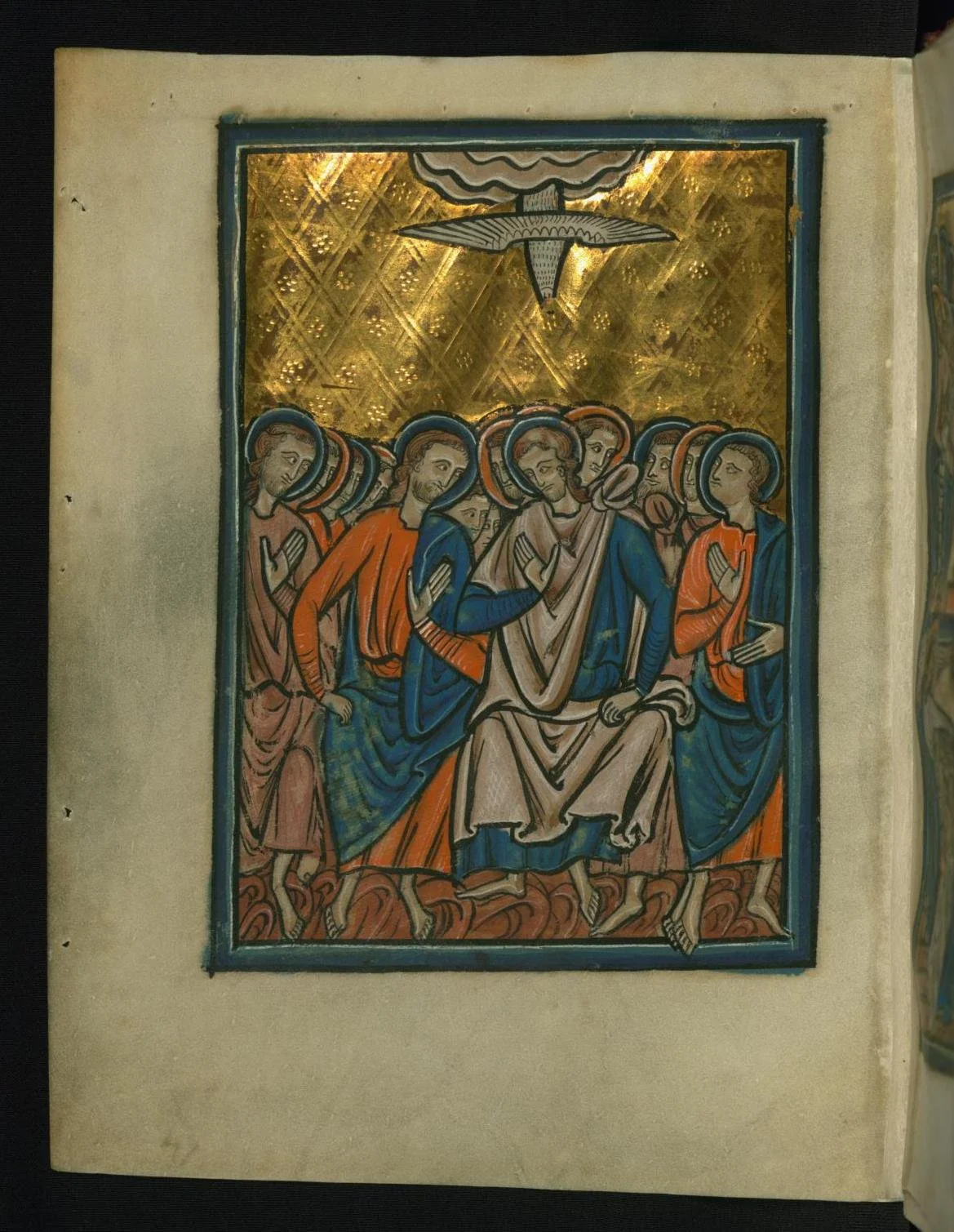
William de Brailes — Pentecost, English manuscript illumination, 13th century. Collection: Walters Art Museum, Baltimore.
The Holy Spirit does not simply confirm what we already know. Sometimes the Spirit invites the Church to change.
A God who is still speaking
In John's Gospel, Jesus says something I find enormously comforting.
"I still have many things to say to you, but you cannot bear them now."
It's a wonderfully gentle sentence.
Jesus knows his disciples are not ready to understand everything.
He knows that some truths take time to grow into.
And he doesn't condemn them for that.
But neither does he leave them there.
"When the Spirit of truth comes, he will guide you into all the truth."
Notice that word: guide.
Not deliver a complete set of instructions.
Not hand over a finished blueprint.
Guide.
There is a journey to be made.
And perhaps that means that the Church is always, in some sense, unfinished.
Not because God has failed to give us enough.
But because the Spirit is still drawing us more deeply into the love and truth of Christ.
Still opening our eyes.
Still widening our understanding.
Still teaching us how to become the people we are called to be.

Perhaps we are called to become attentive gardeners of the life God is already growing among us.
What might God already be growing?
I've found myself thinking about a patch of compost.
Not a particularly glamorous image for the Holy Spirit, I grant you.
But sometimes, at the edges of what looks like ordinary earth, little green shoots begin to appear.
You can't always tell what they are going to become.
You can't force them into bloom by pulling at their stems.
But neither can you abandon the garden and hope for the best.
You have to pay attention.
To notice what's growing.
To make space for it.
To tend it with patience and care.
Perhaps that's something of what the Spirit is asking of us.
To become attentive gardeners of the life God is already growing among us.
To notice gifts in people we might otherwise overlook.
To encourage someone who is still learning.
And to be willing, sometimes, to be surprised.
It seemed good to the Holy Spirit and to us
There's one final thing I love about the Jerusalem Council.
It's not simply that they reach a decision.
It's how they describe it.
Later in the chapter, in the letter they send to the Gentile believers, they write:
It has seemed good to the Holy Spirit and to us.
What an extraordinary phrase.
Not "We have worked everything out."
Not "We are certain that nothing will ever need to change again."
But "It has seemed good to the Holy Spirit and to us."
There is humility in that.
And courage.
They have listened to scripture, to experience, to one another.
They have prayed and argued and discerned.
And now they are willing to take the next step.
That's all any Christian community can do.
We don't possess the Spirit.
We listen for the Spirit.
And we follow.
What is God inviting us to become?
Our Season of Listening has now formally closed, although the listening itself must continue.
Over the coming weeks we'll be reading carefully through what people have shared, and on 6 December we'll begin sharing back what we've heard and what might be emerging.
But perhaps we might each do something very small.
Have a conversation with someone whose story we don't yet know.
Ask someone what they love about this place, or what they wish might be different.
And listen, not to reply or explain, but to discover.
In the end, I don't think the question before us is simply what new activities we should start.
Or how we might persuade more people to come through our doors.
Perhaps the deeper question is this:
What is God inviting us to become?
What gifts are already growing among us?
Whose voices might we not yet have learned to hear?
And are we willing not only to welcome what God is doing, but to let it change us?
I don't know all the answers.
And I think, perhaps, that's rather the point.
Because the Church has never been a finished thing.
It is a people being called, gathered, challenged, forgiven and made new.
Again and again.
By the God who has not finished speaking.
And the Spirit who has not finished leading us.
This reflection is adapted from a sermon preached by Revd Ruth Edmonds at St Philip & St James (Pip & Jim's), Leckhampton, Cheltenham, on Sunday 25 October 2026, as the church's Season of Listening came to a close.