
Remembrance Sunday - 8 November 2026 - a reflection by Rev Ruth Edmonds on Micah 4.1-5 & John 15.9-17
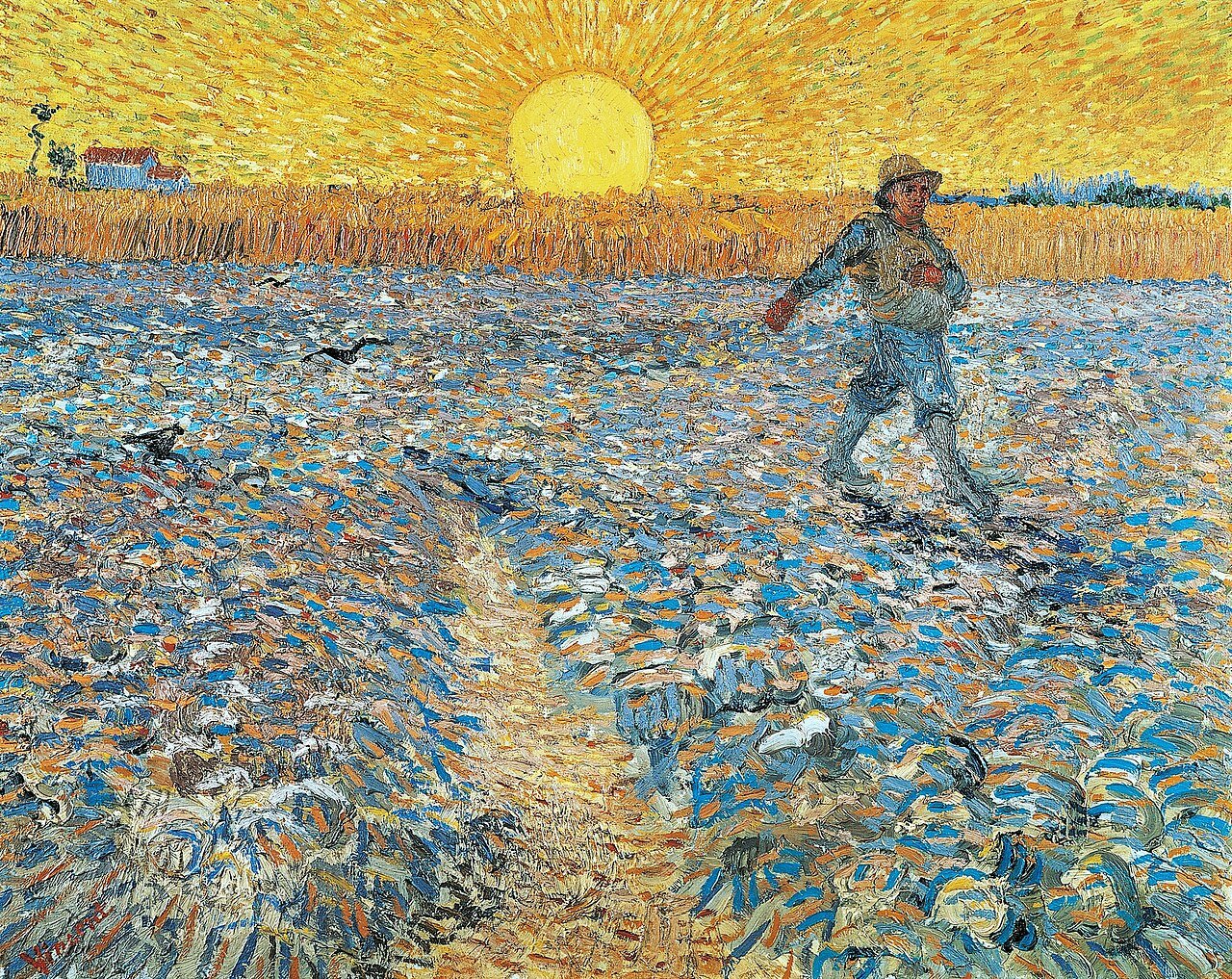
Vincent van Gogh, The Sower (1888). An image of hope, cultivation and the patient work of planting for the future.
A few weeks ago, the government encouraged us all to think more seriously about what we would do in a national emergency.
What if the electricity went off for several days? If the water supply was interrupted? If our phones stopped working?
The advice is sensible. All of those things are possible.
Keep some drinking water and food in the cupboard. Have a torch, essential medication, a plan for how you would contact the people you love when the power turns off or signal becomes unreliable.
We live in an uncertain world. Climate change, war and instability remind us how fragile some of the systems on which our ordinary lives depend really are.
But I've been wondering:
When we imagine a crisis, what do we imagine ourselves doing?
Do we imagine gathering our families inside, shutting the doors, making sure we've got enough to see us through? Do we imagine literally running for the hills?
Or do we imagine going out to see whether our neighbours are all right? To see if our neighbours have food.
Of course, these aren't mutually exclusive. Looking after our families is a good and loving thing. Being prepared ourselves may make us better able to help others.
But there is a difference between preparing because we are frightened, and preparing because we love.
And I wonder what kind of people we become when we are afraid.
Because fear can do strange things to us.
It can make us extraordinarily courageous. We remember that today: people who put themselves in danger to protect others, who risked their lives for friends and strangers.
But fear can also make us selfish.
It can make the boundaries of our concern grow smaller and smaller.
Until the question is no longer, How will we get through this together?
But, How can I make sure I get through it, whatever happens to everyone else?
And our readings today offer us a different vision of what it means to be safe.
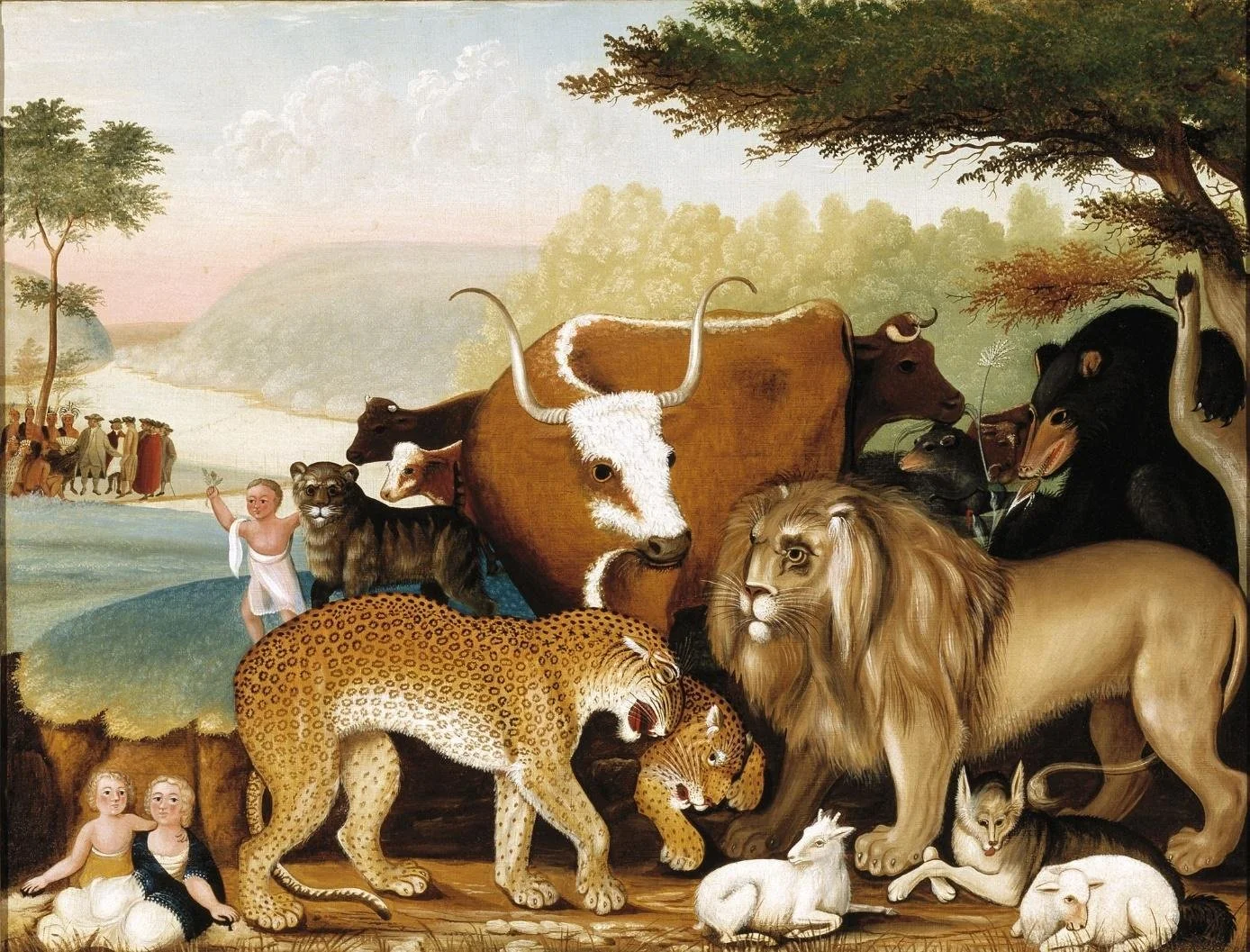
Edward Hicks, The Peaceable Kingdom. A vision of a world where hostility gives way to peace.
A world where no one is afraid
“They shall all sit under their own vines and under their own fig trees, and no one shall make them afraid.” — Micah 4.4
The prophet Micah imagines a world transformed.
A world in which nations no longer make war against one another.
Where swords are beaten into ploughshares, and spears into pruning-hooks. Weapons are made into tools for farming.
The metal that once took life is reshaped to sustain it.
The resources and ingenuity once devoted to war are turned towards growing food, nurturing the earth, helping life to flourish. That’s something we should all be a part of. And if you’re sitting here today and you make weapons for a living, that’s a challenge to take seriously.
But I think the most beautiful part comes a little later.
They shall all sit under their own vines and under their own fig trees, and no one shall make them afraid.
I love that. Not just because I love figs, and I do love figs.
Micah does not describe a grand palace. Not a mighty fortress. Not a world in which one nation has finally defeated all the others.
Just ordinary people, sitting underneath their trees.
With enough to eat.
Somewhere to belong.
And nobody making them afraid.
Because peace, for Micah, isn't simply the absence of war.
It is the presence of everything that makes life worth living.
Food, shelter, security, belonging. A relationship with the land that sustains us. The freedom to watch our children grow up without fearing for their lives.
And notice something else.
Micah doesn't say that some people will sit beneath their vines and fig trees.
He says all.
Not just the powerful. Not just the wealthy. Not just those who have managed to protect themselves against every possible danger.
Everyone.
The measure of peace is not how secure the strongest have become, but whether the most vulnerable can live without fear.
And that is a profoundly challenging vision.
Because so much of what we call security is about protecting ourselves against what might happen to everyone else.
Micah asks us to imagine something more ambitious.
Not simply a world in which we have become better at surviving danger.
A world in which we have begun to remove the conditions that make people so vulnerable in the first place.
-## Remembering the cost of war
And that matters on Remembrance Sunday.
Today we remember people who knew what it meant for the ordinary securities of life to be shattered.
Those who left their homes and families and found themselves in places of unimaginable violence.
Those who died, those who were wounded, those who came home carrying wounds nobody could see.
We remember civilians whose lives were torn apart by war.
And we honour those who served, and those who still serve, often at considerable personal cost.
There is a particular courage in standing between the vulnerable and those who would harm them.
We should never take that courage lightly.
Nor should we pretend that every conflict can be resolved simply by asking people to put down their weapons. We see that in Ukraine, where people have had to defend their homes against invasion.
But there is a difference between recognising that war may sometimes be tragically necessary and accepting that war is inevitable.
Micah refuses to let us settle for that.
God's future is not an endless competition to build more powerful swords.
It is a world in which swords are no longer needed.
And that raises difficult questions.
What do we invest in? What do we prioritise? What kind of security are we trying to create?
A nation might have formidable defences and still be a place where people go hungry.
A society might be extraordinarily wealthy and still leave people without somewhere safe to sleep.
Micah asks us to imagine a security measured not only by military strength, but by whether people can flourish.
Preparing because we love
And this brings me back to the government's invitation to prepare for emergencies.
Because I think we should prepare.
But perhaps we need a more generous imagination of what preparedness looks like.
What if we thought about the strength of our relationships as carefully as the contents of our cupboards?
What if being ready meant knowing who lives next door?
Who would struggle if the electricity went off.
Who lives alone.
Who has no family nearby.
Who might not be able to afford the extra food and water they're being encouraged to put aside.
Because there's something uncomfortable about telling people to prepare for three days without food or electricity when some of our neighbours are already struggling to get through the next three days.
So perhaps Christian preparedness asks us to think not only about what we have stored, but about what we are prepared to share.
Not only about the strength of our homes, but about the strength of our communities.
And not only about surviving a crisis, but about making our society less vulnerable in the first place.
I think that's part of what we are trying to do here.
When people gather for coffee, when we share a meal, when someone visits a person who is lonely, when veterans find companionship, when we offer warmth and hospitality to people who need it.
These things might seem small alongside the great problems of the world.
But they are how relationships are built. How trust grows. How people begin to know that they are not alone.
We cannot care for a community we have not taken the trouble to know.
And perhaps we cannot make peace in the world if we have never learnt to practise it with our neighbours.
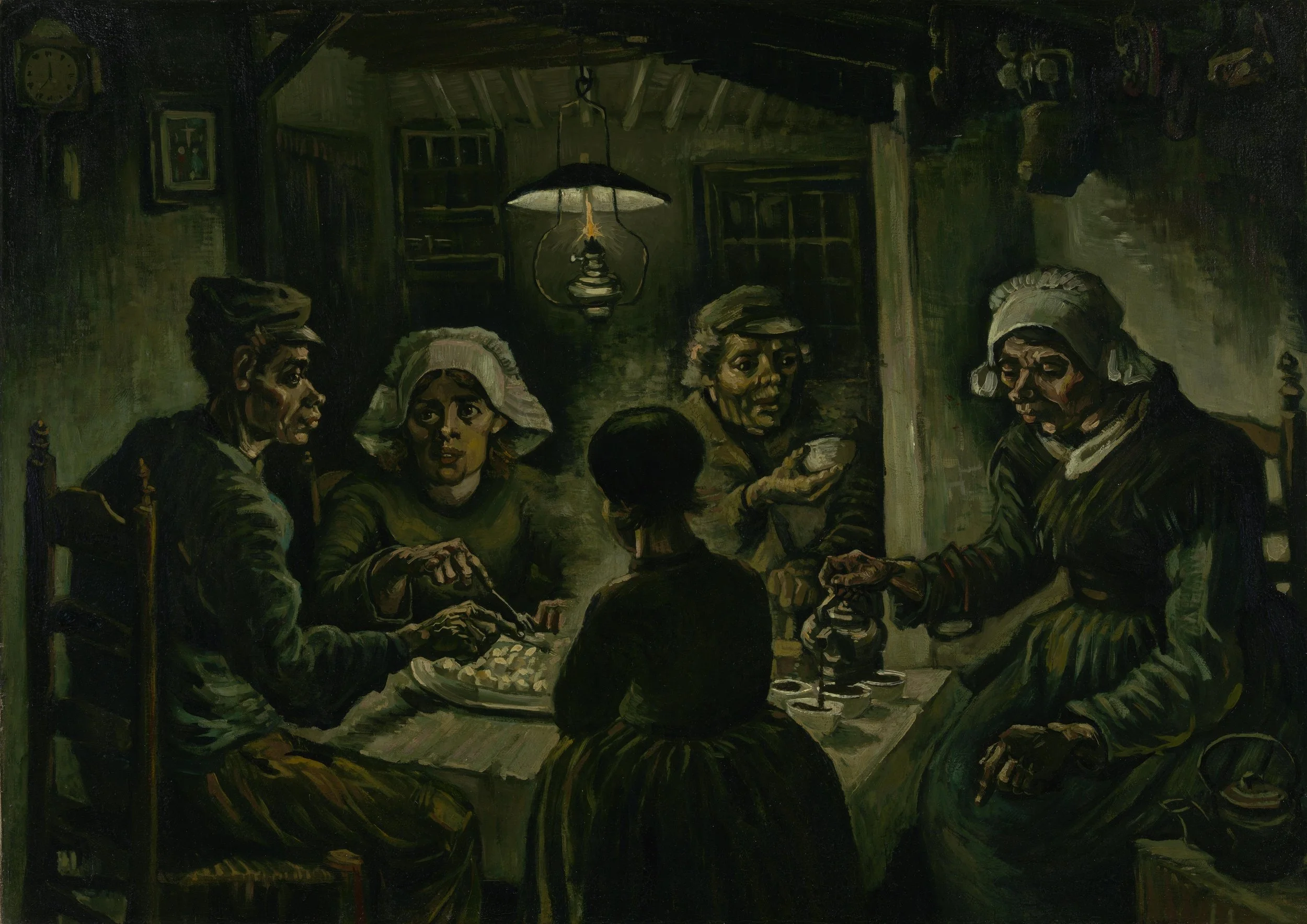
The courage to widen the circle
But fear doesn't just make us want to protect ourselves.
It can make us suspicious of other people.
And that is something we need to be particularly attentive to on Remembrance Sunday.
We know how fear can be manipulated.
How easily people can be persuaded that their troubles are the fault of some other group.
How quickly the stranger becomes a threat, the refugee becomes a burden, the person who thinks differently becomes an enemy.
History teaches us how readily political movements can exploit fear, promising security in exchange for suspicion and exclusion.
And we should recognise that temptation in our own society too.
Of course there are real dangers. We need governments willing to take them seriously.
But there is a difference between helping people prepare for danger and teaching people to be afraid of one another.
Because war doesn't begin only when the first shot is fired.
It always starts earlier than that. We all do some of the work to make war possible. To make the unthinkable killing of other people possible.
When we stop listening.
When we decide that another person's life is worth less than our own.
When we allow fear to shrink the circle of those we are prepared to love.
And this is where Jesus' words become so demanding.
This is my commandment, that you love one another as I have loved you.
Jesus speaks these words on the eve of his death.
He knows that violence is gathering around him.
And what does he tell his disciples?
Not to hate those who threaten them.
Not to retreat into a smaller and safer circle.
He tells them to love.
No one has greater love than this, to lay down one's life for one's friends.
Words we hear so often on Remembrance Sunday, and rightly so. They speak to the extraordinary sacrifice of those who have risked, and sometimes lost, their lives for others.
But Jesus is doing something even more radical.
Throughout his ministry, he has been widening the circle of love.
Eating with outsiders. Welcoming strangers. Challenging the boundaries people draw between those who belong and those who do not.
And at the cross, he refuses to answer violence with hatred.
So perhaps the courage Jesus asks of us is not only the courage to lay down our lives in some extraordinary moment of sacrifice.
It is also the courage to live differently, every day.
To share when we are tempted to hoard.
To welcome when we are tempted to exclude.
To listen when we would rather condemn.
To keep widening the circle of our concern, even when fear tells us to make it smaller.
And Jesus tells us that this is how we bear fruit.
I appointed you to go and bear fruit, fruit that will last.
I find that image beautiful alongside Micah.
Micah imagines people sitting beneath their vines and fig trees, enjoying the fruits of peace.
And Jesus sends his disciples out to bear the fruit of love.
Perhaps that is what the Church is called to be.
A community that helps cultivate the conditions in which others can flourish.
A community that prepares for danger without becoming governed by fear.
A community that takes the threats facing our world seriously, but refuses to surrender its hope.
Fruit that will last
And perhaps that is what it means to remember well.
Micah imagines a world where every person can sit beneath their own vine and fig tree, and no one shall make them afraid.
Not just the wealthy.
Not just the powerful.
Everyone.
And Jesus says to us: Go and bear fruit. Fruit that will last.
Perhaps that is what the courage to make peace looks like.
Planting trees beneath whose shade we may never sit.
Making room at tables where we may never eat.
Building a world in which people we may never meet can live without fear.
Preparing for the worst, while working with stubborn hope for a world in which the worst need never happen.
And trusting that every act of costly love, however small, belongs to God's great work of turning swords into ploughshares.
Amen.